 Skip to content
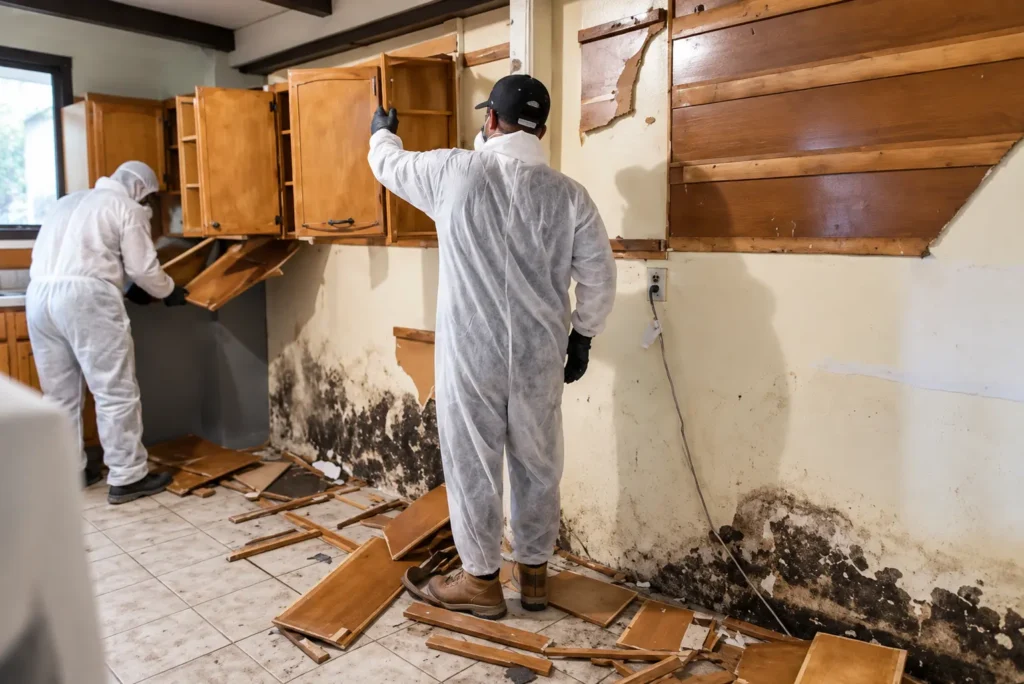
Professional mould remediation can involve assessment, containment, treatment, moisture management, structural drying and restoration, depending on the condition of the property.
Finding mould inside a property usually raises several questions at once.
How far has it spread? Is moisture trapped behind the wall? Will materials have to be removed? How much disruption will the work cause?
Most property owners also want to understand what professional mould remediation involves before agreeing to any work.
At Trade Select Building Restoration, we assess visible mould, affected materials, moisture conditions and the circumstances surrounding the problem before establishing a remediation scope.
The extent of the work depends on what we find.
| Stage | What it may involve | Why it matters |
| Assessment | Visible mould, affected materials and moisture conditions | Helps define the appropriate scope |
| Containment | Controlled work zones, barriers and filtration where required | Helps keep remediation activity controlled |
| Treatment or removal | Cleaning, treatment or removal of affected materials | Addresses contamination within the work area |
| Moisture management | Moisture assessment and structural drying where required | Addresses damp conditions associated with the problem |
| Restoration | Repairs and reinstatement after remediation and drying | Addresses materials that need repair or replacement |
Not every property requires every stage. The process should reflect the conditions identified during assessment.
Mould Remediation Starts With Finding Out What We Are Dealing With
Visible mould provides useful information, but it rarely tells us everything about the affected area.
Growth on a wall or ceiling may be associated with condensation, a plumbing leak, previous flooding, water entering through the building envelope or moisture retained within building materials.
Other properties may have staining or a persistent musty odour while the source remains concealed.
These conditions need to be assessed before deciding how remediation should proceed.
We Look Beyond the Mould You Can See
The assessment considers where mould is visible, which materials appear affected and whether there are signs that moisture extends beyond the obvious area.
The history of the problem can also provide useful context.
A recent leak points the investigation in one direction. Mould that repeatedly returns after cleaning raises different questions. Previous flooding, damp flooring, enclosed cavities or staining around plumbing can each influence what needs closer investigation.
These observations help distinguish a limited affected area from a situation that may require a broader remediation scope.
For property managers, commercial facilities and insurance stakeholders, the assessment can also provide a clearer basis for planning the work. Decisions can follow the conditions found on site rather than relying on the same treatment for every building.
Moisture Conditions Help Shape the Remediation Plan
Persistent moisture can support mould growth, so moisture assessment often forms part of understanding the problem.
Removing visible contamination while leaving wet building materials untreated can result in an incomplete remediation process.
Trade Select’s restoration capabilities include moisture detection and moisture mapping. These methods can help identify dampness that may extend further than surface inspection suggests.
The level of investigation depends on the property. A small, isolated area may require a different approach from mould associated with significant water intrusion.
The purpose is to gather enough information to make informed decisions about the work that follows.
Containment Helps Keep the Remediation Work Controlled
Once the affected area has been assessed, the next consideration is how to carry out the work without unnecessarily spreading contaminated particles into surrounding spaces.
Remediation activity can disturb mould-affected material. Cutting, removing, cleaning or handling these materials may release particles into the air.
Containment helps control that movement.
Why We May Isolate the Affected Area
Depending on the scope, Trade Select may create a controlled work zone around the affected area.
Measures can include physical barriers, protection of nearby materials and contents, and air filtration equipment. HEPA-filtered equipment may also be used to help manage airborne particulates during remediation.
The setup depends on the size, location and condition of the affected area.
A limited residential job can require a different containment arrangement from widespread contamination across a commercial facility. Occupancy, access and surrounding operations can also influence how the work area is established.
The aim is to keep remediation activity within a controlled environment while protecting unaffected areas as far as reasonably possible.
Does Mould Remediation Mean Everything Has to Be Ripped Out?
Property owners are often concerned that professional mould remediation will automatically lead to extensive demolition.
It does not.
Material removal can form part of remediation where conditions warrant it, but the extent of removal should follow the findings from the property rather than a predetermined demolition scope.
Some Materials Can Be Treated, While Others May Need Removal
Building materials respond differently to moisture and contamination.
Some accessible hard surfaces may be suitable for controlled cleaning and treatment. Porous materials can present a different problem, particularly where moisture or contamination has penetrated beyond the surface.
Material condition therefore influences the remediation method.
Plasterboard, insulation, timber, flooring and cabinetry cannot all be treated in exactly the same way. Their construction, porosity, location and exposure to moisture can affect what is practical.
Limited removal may sometimes be required to reach contamination behind a surface or remove material that cannot reasonably be remediated. Other projects may require very little deconstruction.
Removal Should Follow the Condition of the Property
The affected material, extent of contamination and moisture conditions should be assessed before removal is recommended.
Property owners can use this information to understand a proposed scope.
Why does a particular material need to be removed? Is access required behind it? Can the material itself be adequately treated?
A professional remediation scope should be able to explain those decisions.
What Happens During the Mould Remediation Stage?
Containment establishes the work area. Remediation then addresses the affected materials and contamination within it.
Depending on the scope, work may include cleaning, treatment, controlled removal of materials, deconstruction for access and management of airborne particulates.
The method needs to reflect the conditions identified during assessment.
Cleaning Is Different From Covering Up Visible Mould
Removing surface staining alone does not establish whether the underlying mould problem has been addressed.
Painting over discolouration, masking an odour or repeatedly wiping an affected area can change its appearance while moisture or contamination remains.
Mould remediation considers the affected material and surrounding conditions.
Depending on the findings, the work may involve cleaning, treatment, filtration or access to areas behind the visible surface. Where water damage forms part of the problem, moisture assessment can also influence the scope.
The condition of the affected material matters more than whether the surface simply looks cleaner.
Porous and Non-Porous Materials Require Different Decisions
Material type influences what can reasonably be cleaned or treated.
Smooth, non-porous surfaces behave differently from porous products that can absorb moisture or contamination into their structure.
Material that can be effectively treated may remain in place. Material that cannot be adequately remediated may require removal.
Deconstruction may also be needed to reach an affected area concealed behind another building component.
These decisions should follow the actual condition of the property.
Mould Remediation and Moisture Management Often Go Together
Mould growth is frequently associated with damp conditions.
If an affected area remains wet because of a leak, flooding, condensation or another moisture source, remediation may need to address those conditions alongside the contamination.
Victorian Department of Health guidance states that high mould levels are likely when a house has been flooded for more than two days and recommends cleaning and drying flood-affected properties within 48 hours to help prevent mould growth.
This is where mould remediation can overlap with water damage restoration and structural drying.
We Assess Whether Building Materials Are Still Holding Moisture
Surface appearance can be misleading.
A wall may feel dry while moisture remains deeper within the assembly. Flooring, subfloors, plasterboard, timber and enclosed cavities can also retain moisture differently.
Measurements and monitoring can provide more information about those conditions where residual moisture is suspected.
The findings help determine whether drying equipment or further investigation should be incorporated into the remediation plan.
Structural Drying Can Form Part of the Mould Remediation Process
Trade Select Building Restoration provides structural drying services where building materials require additional moisture removal.
Drying strategies can involve air movement, dehumidification and targeted drying equipment selected according to the materials and site conditions.
Equipment operation alone does not establish whether a structure is dry.
Moisture readings and the response of affected materials help guide the drying process. These conditions can also influence the overall remediation timeframe.
A small affected area without ongoing moisture may progress differently from a property where mould has developed after substantial water damage.
The Remediation Timeline Depends on What We Find
One of the first practical questions property owners ask is how long mould remediation will take.
There is no single timeframe that suits every property.
Giving a fixed timeframe before understanding the contamination, affected materials, access requirements and moisture conditions can create expectations that do not match the work required.
Site Conditions Determine the Programme
The size of the affected area has an obvious influence, but it is only one factor.
Material type, containment requirements, accessibility, moisture levels, deconstruction, structural drying and reinstatement requirements can all affect the programme.
A contained area with limited affected material may involve fewer stages. A larger loss involving concealed moisture, removal of materials and subsequent repairs may involve more.
The programme should follow the work required at the property rather than a standard timetable.
Documentation Helps Keep Managed and Insured Projects Clear
Insurance-related losses, commercial sites and managed properties often involve several people who need to understand what is happening.
Property owners, facility managers, insurers, loss adjusters and other stakeholders may require information about the affected area, proposed work and project progress.
Trade Select provides site assessment, reporting and restoration project management services alongside physical restoration work.
This allows mould remediation to sit within a broader project framework where communication, documentation and coordination are required.
Remediation May Be One Stage of Restoring the Property
Completing mould remediation does not always mean the affected part of the building is ready for normal use.
Materials removed during remediation may need to be replaced. Surfaces can require repair. Finishes may need reinstatement.
The next stage depends on how much material was affected by the original problem and what had to be removed during remediation.
Restoration Follows Remediation and Drying
The order of work matters.
Repairing a wall before an affected area has been remediated or adequately dried can interfere with the restoration process and conceal conditions that still need attention.
Once remediation and any required drying stages are complete, reinstatement can be planned around the materials that were removed or damaged.
For one property, this may involve relatively minor finishing work. Another may require broader repairs following a more substantial loss.
We Can Coordinate the Wider Restoration Process
Trade Select’s work extends beyond mould treatment.
Through our Restoration Project Management service, we can coordinate wider restoration activities where a property requires several stages of work.
This can be useful for commercial, managed and insurance-related properties where remediation, drying, repairs, trades and stakeholder communication need to work together.
A coordinated process can also give property owners a clearer view of how the site moves from initial assessment through remediation and into restoration.
Why Moisture Conditions Matter to Mould Remediation
Professional mould remediation can involve more than visible growth when moisture is also affecting the property.
Growth following a leak, flood or other water intrusion can require a different response from isolated surface contamination. Recurring mould can also justify closer investigation of surrounding moisture conditions.
The remediation process therefore needs to connect the findings from the property with the work performed.
Assessment helps define the affected area. Containment helps control the work zone. Remediation addresses affected materials. Moisture management and structural drying may be required where damp conditions remain. Restoration can then address materials requiring repair or reinstatement.
Not every property requires every stage.
Questions Worth Asking Before You Commit to Mould Remediation
How Do We Determine Whether Mould Remediation Is Required?
We assess the visible growth, affected materials, moisture conditions and history of the problem.
A small isolated area can require a different response from recurring mould associated with water damage or contamination that extends into building materials.
Those findings help determine the appropriate scope for the property.
Does Professional Mould Remediation Always Involve Demolition?
No.
Deconstruction may form part of remediation where affected materials need to be removed or access is required behind them.
The decision depends on material condition, porosity, contamination, moisture exposure and whether the affected area can be adequately remediated.
Assessment should provide the basis for that decision.
How Long Does Mould Remediation Normally Take?
There is no single timeframe that suits every property.
Area size, material type, containment, removal work, accessibility, moisture conditions, structural drying and subsequent restoration can all affect the programme.
Those factors need to be assessed before determining what the work is likely to involve.
Can Mould Return After Remediation?
Mould can develop again if suitable growth conditions remain or occur later.
For that reason, moisture sources and damp building materials are considered where they are relevant to the affected area. Managing those conditions can form part of the remediation and drying process.
A responsible scope addresses the conditions present at the time without making unrealistic promises about every future environmental condition within a property.
What Happens to Walls, Flooring or Other Materials That Cannot Be Remediated?
Affected materials may need to be removed where they cannot be adequately treated or where access behind them is required.
Reinstatement can follow once remediation and any necessary drying work have been completed.
The repair scope depends on what was removed and the condition of the surrounding property.
Can You Help With Mould Remediation on Insurance or Commercially Managed Properties?
Yes.
Our restoration work includes residential, commercial and insurance-related environments.
Projects involving property managers, insurers, adjusters and other stakeholders may require site assessment, reporting, defined scopes and coordination alongside the physical remediation work.
Our restoration project management capabilities allow us to support that broader process where required.
What Should I Do if I Am Unsure How Extensive the Mould Problem Is?
An assessment provides a practical starting point.
Visible mould does not always show the full extent of the affected area, particularly where moisture or contamination may extend into building materials or concealed spaces.
Trade Select can assess the conditions, identify what requires further investigation and recommend an appropriate course of action.
If You Cannot Tell How Far the Mould Extends, Start With an Assessment
Professional mould remediation does not require property owners to diagnose the entire problem before asking for help.
Our role is to assess what has happened, identify the affected materials and determine whether moisture or water damage is contributing to the mould growth.
At Trade Select Building Restoration, our mould removal and remediation process can progress from assessment into containment, treatment, material removal, structural drying and restoration where those stages are required.
The scope follows the condition of the property.
If you are dealing with mould in a home, commercial building, rental property or managed facility and need a clearer picture of what remediation may involve, contact our team to discuss the property and arrange an assessment.
