
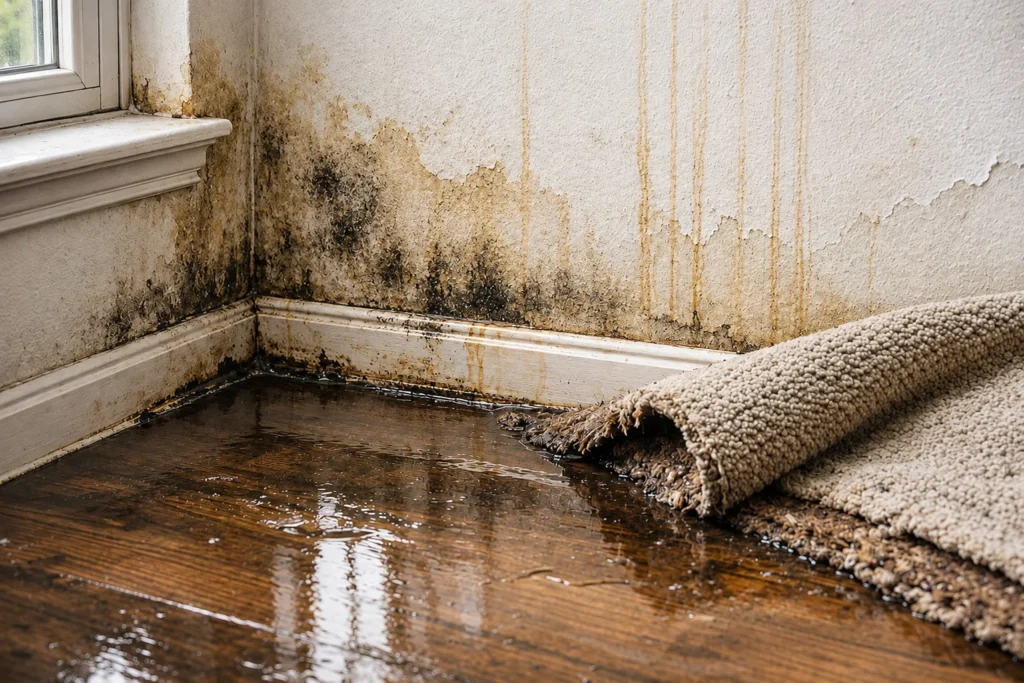
Water damage restoration involves more than removing standing water and repairing visible damage. A burst pipe can saturate flooring and walls within minutes, while a roof leak may allow moisture to collect in ceiling cavities before anyone notices. Floodwater can also move beneath floor coverings, behind skirting boards and into adjoining rooms.
At Trade Select Building Restoration, we assess affected areas, investigate moisture movement and determine what work is needed before repairs begin. Depending on the damage, this may involve water extraction, removing unsuitable materials, structural drying and moisture monitoring.
For homeowners, property managers and insurers, understanding the water damage restoration process helps explain why repairs cannot always begin as soon as visible water disappears.
What to Do Immediately After Water Damage
When water enters a property, the first priority is safety. Water near electrical installations, unstable ceilings and potentially contaminated floodwater can make an affected area unsafe to enter.
The immediate response should focus on stopping further water entry where this can be done safely, identifying potential hazards and arranging an assessment.
Control the Water Source Before Starting Restoration
If a plumbing pipe has burst, isolating the water supply may limit further damage. Where a roof has been damaged, temporary protection or repairs may be needed to prevent additional water entering the property.
Do not enter areas where electricity may be present in standing water, and avoid disturbing ceilings that appear swollen, sagging or unstable. Water-damaged electrical installations and equipment need professional assessment before use.
The NSW State Emergency Service’s electrical safety guidance advises that electrical connections and appliances affected by water should be inspected by a licensed electrician before being used again.
Floodwater and sewage-affected areas may also contain harmful contaminants. These require a different approach from a minor leak involving otherwise clean water, particularly when carpets, insulation or other absorbent materials have been affected.
Once the water source is controlled and the property is safe to access, restoration can move to assessing the extent of the damage.
What to Do While Waiting for a Water Damage Assessment
Property owners can take several practical steps while arranging professional assistance, provided the affected areas are safe.
- Stop further water entry where safe. Isolate an accessible water supply if a plumbing leak is responsible.
- Photograph visible damage. Record affected rooms, flooring, walls, ceilings and belongings without entering hazardous areas.
- Record what happened. Note when the damage was discovered, the suspected water source and any steps taken to control it.
- Avoid disturbing contaminated materials. Sewage-affected or flood-damaged materials may need specialist handling.
- Leave uncertain material removal to the assessment. Some components may be suitable for drying, while others may need to be removed.
Avoid using electrical equipment in wet or potentially unsafe areas. If the damage involves extensive flooding, structural concerns or suspected contamination, keep clear until the appropriate professionals have assessed the risks.
For assistance with the next steps, contact Trade Select Building Restoration and provide details of the affected property and water source.
Why Standing Water and Wet Building Materials Need Different Treatment
Standing water is usually visible across floors or in low-lying areas. Moisture absorbed into building materials can be harder to identify.
Plasterboard, timber, carpet underlay and insulation may retain water after the surface appears dry. Concrete and masonry can also hold moisture that needs assessment before subsequent building work.
Water extraction removes accessible liquid water. Structural drying addresses moisture retained within suitable building materials.
Depending on how far water has travelled, both processes may be necessary. Removing visible water alone does not establish that concealed spaces or materials are ready for repairs.
How We Assess Water Damage
Once the water source has been controlled and the property is safe to enter, restoration begins with identifying how far moisture has travelled and which materials have been affected.
At Trade Select Building Restoration, we inspect affected areas, assess concealed moisture and determine whether materials can be dried or need further treatment. The assessment helps establish a restoration plan covering extraction, material removal where necessary, structural drying and monitoring.
The usual progression is safety and source control, moisture assessment, extraction and material treatment, structural drying, drying verification, then building repairs. The work may overlap or require further investigation depending on the property’s condition.
Identifying Affected Rooms and Concealed Moisture
Water can travel further than the visible damage suggests. A roof leak may saturate insulation before staining appears on the ceiling, while water beneath flooring can spread into adjoining areas.
Our assessments may involve moisture meters, hygrometers, thermal imaging and moisture mapping.
Moisture meters help assess suitable building materials, while hygrometers measure conditions in the surrounding air. Thermal imaging can highlight temperature differences that warrant further investigation, but it does not measure moisture directly or confirm that a surface is wet.
Moisture mapping records where elevated readings are found and helps identify areas requiring treatment or monitoring. The findings are considered alongside the building’s construction, the water source and the condition of affected materials.
The type of water is also relevant. Materials affected by a plumbing leak may require different treatment from those exposed to sewage or contaminated floodwater.
Establishing the Extraction and Drying Requirements
The assessment helps determine which materials can reasonably remain in place and which need removal or further investigation.
For example, wet carpet may be suitable for extraction and drying in some circumstances. If the underlay is contaminated or the flooring prevents access to trapped moisture, removal may be necessary.
Similarly, wall linings may need to be opened where concealed moisture cannot otherwise be assessed or treated effectively.
The restoration plan should reflect the condition of each affected area rather than assuming that every material in the room needs the same treatment.
Water Extraction and Material Assessment
Water extraction reduces the amount of accessible liquid water that subsequent drying must address. The method depends on the quantity of water, the surfaces affected and any contamination concerns.
Professional extraction equipment may be used for standing water, wet carpets and other suitable materials. After extraction, the remaining moisture and material condition determine what happens next.
Removing Water From Accessible Areas
Hard flooring, carpets and other affected surfaces can require different extraction methods. Equipment must be appropriate for the material and the conditions at the property.
Contamination can affect whether an item can be retained. Carpet exposed to a clean-water leak should not automatically receive the same treatment as carpet affected by sewage.
Once accessible water has been removed, further inspection may identify areas requiring controlled drying, cleaning or selective material removal.
Where water has entered concealed spaces, removing surface water may be only the first stage of restoration.
Assessing Carpets, Insulation, Flooring and Wall Cavities
Building materials respond differently to water exposure. Their condition, absorbency, contamination risk and drying potential all influence whether they can be retained.
| Building material | Potential effect of water | Restoration consideration |
| Carpet and underlay | Water retained in backing and underlying layers | Assess contamination, condition and drying suitability |
| Timber flooring | Swelling, distortion or retained moisture | Measure moisture and assess material condition |
| Plasterboard | Softening or deterioration after saturation | Determine whether drying or removal is appropriate |
| Insulation | Water retained within concealed cavities | Assess contamination, access and replacement needs |
| Concrete and masonry | Moisture may remain after the surface dries | Check retained moisture before subsequent work |
The time materials remain wet is especially relevant when mould is a concern.
In its workplace mould-clean-up guidance, SafeWork NSW advises discarding porous materials such as carpets, plasterboard and insulation if they cannot be readily cleaned, have remained wet for more than 48 hours, or show visible mould growth.
This guidance relates to managing mould risks at workplaces. It is not a blanket rule that every water-damaged material must be replaced after 48 hours. A restoration assessment still needs to consider contamination, material condition, exposure history and the intended treatment.
Selective removal may be necessary where material cannot be restored or prevents access to affected framing, subfloors or wall cavities.
The aim is to retain suitable materials where practical without leaving contamination or unresolved moisture concealed inside the building.
Structural Drying and Moisture Monitoring
After accessible water has been removed, moisture retained within suitable building materials may require controlled structural drying.
This process uses appropriate drying equipment and environmental monitoring to reduce moisture in affected surfaces and building assemblies. The drying approach depends on the material, construction, extent of water exposure and conditions at the property.
How Dehumidifiers and Air Movers Support Drying
Dehumidifiers remove moisture from the air, helping create conditions that encourage damp materials to release retained water.
Air movers improve airflow across suitable surfaces, supporting evaporation. In some circumstances, targeted drying equipment may be used for wall cavities, flooring systems or other affected building assemblies.
The equipment and its placement need to suit the conditions. Strong airflow or additional heat does not automatically produce better results, particularly where materials are sensitive or contamination may be present.
At Trade Select Building Restoration, we consider the affected materials, surrounding conditions and any contamination concerns when determining an appropriate drying approach.
How We Monitor Drying Progress
Drying progress should be measured rather than assumed from the amount of time equipment has been operating.
Moisture readings and environmental monitoring help show how affected materials are responding. Where appropriate, readings may be compared with unaffected materials of similar construction to help establish suitable drying goals.
The time required varies. Timber flooring, plasterboard and concrete substrates can respond differently according to their construction, moisture exposure, humidity and access for drying.
A surface that feels dry is not necessarily ready for reinstatement. The decision to finish drying should be supported by appropriate measurements and the condition of the affected materials.
When Can Water Damage Repairs Begin?
Building repairs can be planned once the necessary drying, cleaning and remediation work has been completed and the affected areas are suitable for reinstatement.
Repairing visible damage prematurely may conceal unresolved problems. Replacing skirting boards over damp wall materials or installing new flooring over a wet substrate can lead to further work later.
The handover from restoration to building repairs should therefore be based on the assessed condition of the property, not simply its appearance.
Documenting Drying Progress and Building Conditions
Inspection findings, moisture readings, photographs and records of completed work help explain what has been assessed and treated.
These records support communication between property owners, insurers, restoration specialists and building contractors. They can also help establish which repairs remain necessary and which materials have been retained or removed.
Trade Select Building Restoration provides assessments and reporting alongside its restoration services. Documentation requirements vary between projects, but accurate records provide a clearer basis for the subsequent repair scope.
Coordinating Restoration With Building Repairs
When the affected areas are ready for reinstatement, the remaining work may involve plastering, painting, flooring, carpentry or other building trades.
The repair scope should reflect the damage and any materials removed during restoration. In some cases, additional repairs may also be required to address the original cause of water entry.
Through our restoration project management services, we help coordinate the transition between restoration work and subsequent repairs where required.
This helps property owners, managers, insurers and contractors work from a clearer understanding of the property’s condition and the remaining building work.
Water Damage Restoration FAQs
What Should I Do Immediately After Discovering Water Damage?
Keep clear of electrical hazards, unstable materials and potentially contaminated water. Stop the source if this can be done safely, record visible damage and arrange an assessment.
Does All Wet Plasterboard Need Replacing?
No. The decision depends on contamination, material condition, exposure duration and whether effective drying is possible. Damaged, mould-affected or unsuitable plasterboard may require removal.
How Long Does Structural Drying Take?
Drying times vary according to the materials, extent of water exposure, building construction and environmental conditions. Moisture monitoring helps determine when appropriate drying goals have been reached.
Can Water Remain Inside Walls After the Surface Looks Dry?
Yes. Framing, insulation and other concealed materials may retain moisture after exposed surfaces appear dry. Further assessment may be needed before repairs begin.
Can Trade Select Help With Insurance-Related Water Damage Restoration?
Yes. Trade Select Building Restoration provides restoration assessments, drying, documentation and project coordination for insurance-related property damage. Insurance coverage and claim approval remain matters for the insurer.
Arrange a Water Damage Assessment
A burst pipe, roof leak or flood can affect more of a property than the visible damage suggests. An assessment helps establish where moisture has travelled, which materials need treatment and what must be completed before repairs can begin.
Trade Select Building Restoration provides water extraction, moisture assessment, structural drying and restoration support for affected residential and commercial properties.
Contact our water damage restoration team or call 1800 953 584 to discuss the affected property, the source of water and the next appropriate steps.