
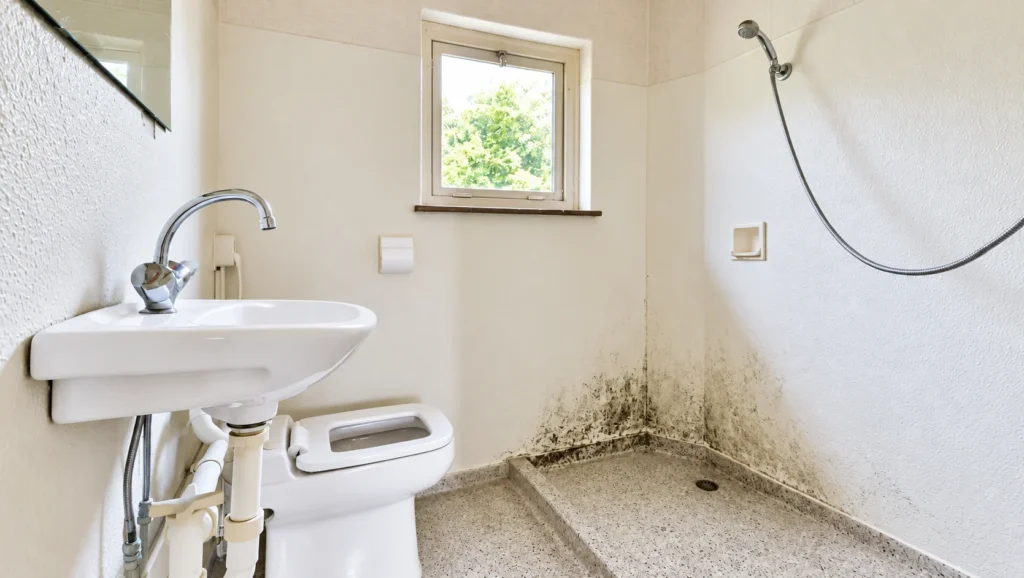
Bathroom mould has an annoying habit of returning to the same places.
You clean the ceiling. The dark spots disappear. The grout looks better. A few weeks or months pass, then the marks start appearing again around the ceiling, walls, shower area or other damp corners.
Another round of cleaning may deal with what you can see. It may not change the conditions allowing the mould to return.
Bathrooms create moisture through showers, baths and wet surfaces. Condensation and slow drying can contribute to mould growth, particularly where ventilation is limited. In other properties, the problem may involve a plumbing leak, water ingress or damp building materials.
The visible mould does not always tell the whole story.
At Trade Select Building Restoration, we look at the surrounding conditions before deciding what response makes sense. Sometimes the practical answer is better moisture control. Sometimes closer inspection is warranted. If affected materials or concealed moisture are involved, the scope may extend to drying, mould removal or remediation.
Why Bathroom Mould Keeps Returning
Cleaning can remove visible mould from suitable surfaces and improve the appearance of the bathroom.
The important question is what happens afterwards.
If a bathroom repeatedly becomes damp and takes a long time to dry, the conditions that support mould growth can return even after the surface has been cleaned.
The same applies if water is entering a wall, ceiling or adjoining material from another source.
This is why some bathrooms fall into a cycle of cleaning, temporary improvement and recurrence.
Bathroom Mould Can Return After Cleaning
Recurring mould does not automatically mean the previous cleaning was ineffective. The area may simply have become damp again.
A bathroom produces moisture every day. Warm, moisture-laden air can reach cooler surfaces and form condensation. Walls and ceilings may remain damp if the room dries slowly. Grout, sealants, windows and corners can also stay wet after the shower has been turned off.
Repeated moisture creates conditions in which mould can return.
A leak or damp building material can create moisture independently of shower steam. In that situation, surface cleaning may improve what you see while leaving the source of the moisture unresolved.
Recurring Mould Can Provide Clues
The location and pattern of recurring mould can help indicate what to investigate next, although they should not be treated as a diagnosis.
Growth spread across cooler ceiling areas may fit a condensation pattern. Mould concentrated around one section of wall, beside plumbing or beneath water staining may justify a closer look for a localised moisture source.
Timing can also help.
A bathroom that becomes visibly wet after every shower and takes a long time to dry points towards moisture management and airflow as areas worth examining.
A patch that remains damp regardless of bathroom use raises different questions.
These observations are useful clues, but the surrounding conditions need to be considered before drawing conclusions.
How Condensation Contributes to Bathroom Mould
Bathrooms are designed around water, so some temporary moisture is unavoidable.
Problems can develop when that moisture repeatedly settles on surfaces and remains there.
A hot shower increases the amount of water vapour in the room. When warm air reaches cooler walls, ceilings, windows and fittings, some of that moisture can condense.
Effective extraction and drying help remove it. Limited airflow can leave surfaces damp for longer.
Under the National Construction Code 2022, bathroom exhaust systems covered by its Deemed-to-Satisfy provisions require a minimum airflow rate of 25 litres per second. Certain bathrooms without adequate natural ventilation also require an exhaust fan that continues operating for 10 minutes after the light is switched off. These requirements highlight the role of effective moisture extraction in reducing condensation. An existing fan may warrant inspection if the bathroom consistently remains damp after use.
Over time, the same areas can become recurring mould sites.
Signs That Steam, Humidity and Ventilation May Be Contributing
Several everyday signs can point towards condensation and slow drying.
A mirror that stays fogged long after a shower suggests moisture is lingering in the room. Water droplets on ceilings or walls show that vapour is condensing on those surfaces. Damp towels, persistent moisture around windows and a bathroom that remains humid well after use can indicate similar conditions.
An exhaust fan may also be present without providing enough effective air movement for the space or the way the bathroom is used.
These observations do not prove that ventilation is the only cause, but they provide a sensible place to start.
| What you notice | What it may suggest | What it does not prove |
| Mould across cooler ceiling areas | Condensation or slow drying may be contributing | That ventilation is the only cause |
| Fogged mirrors and lingering humidity | Moisture is remaining in the room after use | That there is no leak elsewhere |
| Mould concentrated near plumbing | A localised moisture source may warrant investigation | That a plumbing leak is definitely present |
| Peeling paint or water staining | The area may need closer moisture assessment | The exact source of the moisture |
| Mould keeps returning after cleaning | The conditions supporting growth may still be present | That professional remediation is automatically required |
If improved airflow, extraction and drying change the pattern of recurrence, that is useful information.
If mould continues to return in the same area despite those changes, another moisture source may need to be considered.
When Ventilation Is Not the Whole Problem
Ventilation contributes to many bathroom mould problems, but it cannot explain every wet wall or stained ceiling.
Bathrooms contain plumbing connections, wet areas and adjoining building materials that can be affected by leaks or water ingress. Moisture can also enter from spaces above or beside the bathroom.
The presence of mould shows that conditions have supported growth. It does not identify exactly where the moisture came from.
Bathroom Ceiling Mould Can Have More Than One Cause
Bathroom ceiling mould often develops where warm, moist air reaches cooler ceiling surfaces.
Other signs can change the picture.
Localised staining, bubbling paint, soft or damaged material, persistent dampness or a history of water entering from above can justify investigating the ceiling more closely.
A roof leak, plumbing issue or moisture from another part of the building can sometimes affect a bathroom ceiling.
The surrounding evidence helps determine whether the issue is likely to involve more than condensation.
Bathroom Wall Mould May Need Closer Investigation
Bathroom walls present a similar challenge.
Visible mould around a shower or frequently wet surface may fit the normal moisture pattern of the room.
Growth that repeatedly appears around one plumbing location, beside cabinetry or on a wall that feels damp deserves closer attention.
Paint can conceal early signs of water-affected material. Moisture can also move through or behind building elements before it becomes obvious on the exposed surface.
That is why recurring bathroom mould cannot always be diagnosed from a photograph or visible patch alone.
Signs of Hidden Moisture
A bathroom can look dry several hours after use while moisture remains within a material or concealed space.
Surface appearance has limits.
Plasterboard, timber, flooring systems and other materials can behave differently after water exposure. Cavities also prevent direct visual inspection, so a dry-looking wall does not confirm the condition behind it.
This becomes more relevant after a leak, previous water damage or recurring mould in the same location.
Hidden Moisture Behind Bathroom Walls and Ceilings
Repeated staining in one area, peeling paint, bubbling finishes, damaged plasterboard, a persistent musty odour or a history of leakage can all justify further investigation.
None identifies the source on its own.
Our mould inspection work is aimed at identifying the presence, source and extent of contamination.
Depending on the property and the concern being investigated, moisture measurements and other diagnostic methods can help assess conditions that are difficult to judge from appearance alone.
This provides a better basis for deciding whether the problem is mainly related to surface moisture, a building moisture issue or a combination of factors.
When Bathroom Mould Needs More Than Cleaning
Recurring bathroom mould does not automatically mean professional remediation is required.
The pattern can help indicate what to investigate next.
If mould develops alongside obvious post-shower condensation, slow drying and limited ventilation, improving moisture control may be a sensible first step.
If growth repeatedly returns in one location, particularly alongside water staining, persistent dampness, deteriorating finishes, musty odours or a history of leaks, closer investigation may be warranted.
Some Patterns Fit Condensation and Slow Drying
A condensation-driven pattern often has a clear relationship with bathroom use.
The room becomes steamy. Surfaces collect moisture. The bathroom takes a long time to dry. Mould gradually develops on the ceiling, wall corners or other cooler areas.
Improving extraction, airflow and drying can reduce those conditions.
If the changes improve the problem, that provides useful information. If mould continues returning despite better moisture control, another source may need to be considered.
When a Professional Inspection Makes Sense
Professional investigation becomes more useful when the cause is no longer obvious.
Mould that repeatedly returns after cleaning, unexplained damp areas, water staining, material deterioration, musty odours and known previous leaks can all justify closer assessment.
Our mould inspection service is designed for this investigative stage.
You do not need to decide in advance that the bathroom requires remediation.
The purpose of inspection is to establish better information before deciding what work, if any, should follow.
What a Professional Mould Inspection Looks For
Inspection and mould removal serve different purposes.
Inspection is diagnostic. We use it to investigate the presence, source and extent of the problem.
Removal or remediation may follow if the findings show those services are appropriate.
Keeping those stages separate helps avoid deciding on a solution before the problem has been properly assessed.
What We Consider During a Mould Inspection
We start with the visible conditions and the history of the problem.
That can include where the mould appears, how often it returns, whether previous water damage has occurred and whether the room shows signs of persistent dampness.
We then consider moisture conditions alongside the affected materials.
Our wider diagnostic capability includes moisture measurement, moisture mapping and thermal imaging where those methods suit the investigation.
One inspection may point towards condensation and moisture management. Another may identify signs that a leak, wet material or concealed area requires further attention.
In more involved cases, structural drying or remediation may form part of the next stage.
Addressing the Moisture Path Can Help Break the Cycle
Mould treatment makes more sense once the contributing conditions are better understood.
Cleaning an affected surface can form part of the response.
Moisture management can form another.
If water-affected materials are involved, drying or repairs may also need to be considered.
Some properties require a broader mould-removal scope.
The appropriate sequence depends on the property conditions and inspection findings.
When Mould Removal or Remediation May Be Needed
Our mould removal and remediation capability can include assessment, containment, removal of contaminated materials, structural cleaning and other remediation measures according to the scope of the loss.
That level of work is not an automatic response to every bathroom mould patch.
We use the inspection findings and property conditions to establish whether professional removal or remediation is warranted.
This keeps the scope connected to the problem rather than applying the same response to every case.
Some Bathroom Mould Problems Need More Than Cleaning
A small amount of visible surface mould and a broader moisture-related restoration problem can look similar at first.
Their solutions can be very different.
Affected porous materials may behave differently from hard surfaces. Hidden moisture may need to be addressed. A leak may require repair. Wet materials may require drying. Contamination extending beyond the visible area may call for a more controlled remediation process.
Investigation helps distinguish between these situations.
That can help property owners, tenants, landlords and managers avoid repeatedly treating the visible symptom while a moisture problem remains unresolved.
What to Do When Bathroom Mould Keeps Returning
Recurring bathroom mould often leaves people asking the same question: what are we missing?
Sometimes the answer is the way the room handles condensation.
Sometimes water is entering from somewhere else.
In other cases, damp materials require closer assessment.
Start with what you can observe.
Look at how the bathroom behaves after use. Pay attention to where mould returns. Take water staining, deteriorating finishes and persistent dampness seriously. Consider whether the growth continues even after ventilation and drying conditions improve.
If the source remains unclear, a professional inspection can help establish whether you are dealing with a surface moisture issue, a hidden water problem or conditions that may require mould removal or remediation.
Contact Trade Select Building Restoration if your bathroom mould keeps returning and you want to understand what may be happening behind the visible surface.
Bathroom Mould FAQs
Why does bathroom mould keep coming back after I clean it?
Recurring mould usually indicates that suitable moisture conditions are returning.
In bathrooms, condensation, limited airflow and slow drying can contribute. Leaks, water ingress or damp building materials may also be involved.
Cleaning deals with the visible growth at that point in time. Understanding why it returns requires looking at the moisture conditions around it.
Does bathroom ceiling mould always mean the ventilation is inadequate?
No.
Condensation and limited ventilation can contribute to ceiling mould, but they are not the only possible explanations.
Localised water staining, damaged finishes, persistent dampness or a history of leakage can justify investigating other moisture sources.
How can I tell whether bathroom mould is caused by condensation or a leak?
Patterns can provide clues.
Condensation often follows bathroom use and may affect cooler surfaces across a wider area.
A leak may produce more localised dampness, staining or material damage that does not closely follow shower use.
Neither pattern should be treated as proof without further investigation.
Can mould develop behind a bathroom wall or ceiling?
Yes.
Concealed spaces and building materials can be affected by moisture without the full extent being visible from the room.
Recurring growth, previous water damage, unexplained dampness or deteriorating finishes can provide reasons to investigate beyond the exposed surface.
Will improving ventilation stop bathroom mould permanently?
Improved ventilation can help where condensation and slow drying are major contributing factors.
It cannot resolve an active plumbing leak, water ingress or wet building material.
The result depends on which moisture source is supporting the mould.
When should recurring bathroom mould be professionally inspected?
Inspection becomes sensible when mould keeps returning and the reason is unclear, particularly if you also notice staining, persistent dampness, musty odours, damaged materials or evidence of previous water intrusion.
An inspection can help establish the source and extent before removal or remediation is considered.
Does bathroom mould automatically mean I need professional mould removal?
No.
Some situations may be addressed through moisture control and appropriate cleaning.
Others may involve affected materials, concealed moisture or wider contamination that calls for professional removal, drying or remediation.
The property conditions should determine that decision.
What should I do if I cannot work out why the mould keeps returning?
Repeated cleaning may not resolve the problem if the moisture conditions remain.
We can assess the visible mould, surrounding moisture conditions and affected materials to help establish what may be contributing to the recurrence.
From there, we can recommend the next practical step based on what the investigation shows.