 Skip to content
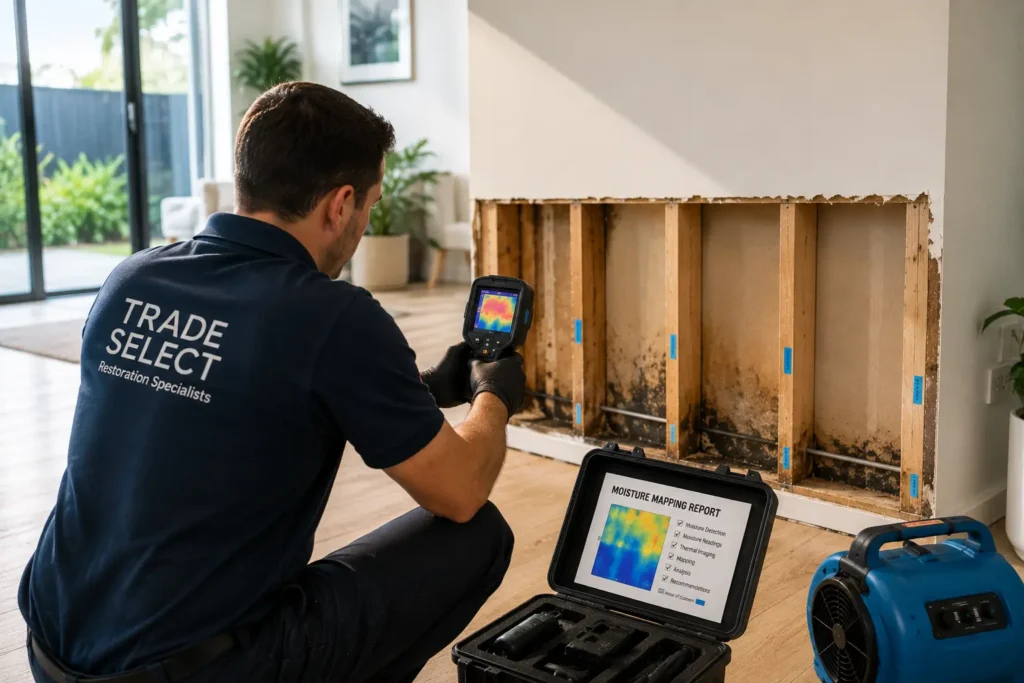
Water damage is not always visible.
A wall may feel dry while moisture remains inside the cavity. Flooring may look stable even though water has spread underneath it. A leak may have stopped, but affected materials can continue holding moisture long after the immediate incident.
Moisture mapping helps identify what a visual inspection can miss. It provides recorded evidence of where moisture is present, how far it may have spread and which areas require drying, monitoring, removal or further investigation.
For insurers, builders, strata managers and commercial property owners, that evidence supports clearer scoping, reporting and restoration decisions.
What is moisture mapping?
Moisture mapping is the process of locating, measuring and documenting moisture across an affected property.
A technician assesses visible and concealed areas using tools such as moisture meters, thermal imaging cameras and hygrometers. The findings are then recorded to create a clearer picture of the affected area.
Moisture mapping may identify moisture:
- behind walls
- beneath floor coverings
- within plasterboard, timber or insulation
- around ceilings and cavities
- across adjoining rooms or materials
- in areas that appear dry at the surface
The purpose is not simply to confirm that water was present. It is to understand the extent of the problem before restoration work begins.
Why hidden moisture is often missed
Water does not always remain close to the source of a leak.
It can move beneath flooring, travel through wall systems, settle in low points or soak into porous materials. Some surfaces dry quickly while moisture remains trapped behind or underneath them.
This can create the impression that a property is ready for repairs when affected materials are still wet.
Without proper testing, hidden moisture may contribute to staining, odours, deterioration, mould-related concerns or incomplete drying. It can also lead to repairs being carried out before materials have returned to suitable moisture levels.
Moisture mapping reduces that uncertainty by replacing assumptions with recorded findings.
Moisture mapping compared with a visual inspection
A visual inspection is useful, but it cannot always show the full extent of water damage.
| Visual inspection | Moisture mapping |
| Identifies visible staining or damage | Records moisture readings across affected areas |
| Relies mainly on what can be seen or touched | Uses moisture meters and supporting equipment |
| May miss moisture behind finishes | Helps locate concealed moisture patterns |
| Provides an initial overview | Supports drying, monitoring and repair decisions |
| Can identify obvious problem areas | Helps define the likely restoration scope |
A visual inspection identifies symptoms. Moisture mapping helps define the extent of the problem.
Illustration opportunity: Add a simple cross-section showing visible wall damage on the surface and concealed moisture inside the wall cavity.
When should moisture mapping take place?
Moisture mapping should take place as early as practical once the property is safe to inspect.
Early assessment helps establish the affected area before drying, removal or repair work begins. This can reduce the risk of concealed moisture being missed and gives the restoration team a more reliable basis for planning.
Moisture mapping may be useful after:
- burst or leaking pipes
- overflowing appliances or fixtures
- roof or stormwater ingress
- flooding
- sprinkler discharge
- water entering through walls, ceilings or floors
- water damage in strata or commercial properties
- previous drying work where moisture is still suspected
Mapping may also be repeated during drying. Follow-up readings help show whether moisture levels are falling and whether additional work is required.
What happens during a moisture mapping assessment?
The exact process depends on the property and the type of incident, but a professional assessment will usually include the following stages.
Initial inspection
The technician reviews the incident, identifies the likely water source and inspects visible damage. They may also assess adjoining rooms, lower levels or connected materials where water could have travelled.
Moisture testing
Moisture meters are used to assess materials and compare readings across affected and unaffected areas.
Different types of meters may be used depending on the surface, material and level of detail required.
Thermal imaging
Thermal cameras can help identify temperature differences that may suggest possible moisture patterns behind surfaces.
It does not confirm moisture by itself. Suspected areas should be checked with appropriate moisture-testing equipment.
Environmental readings
Hygrometers may be used to measure relative humidity and air temperature. These readings help assess the indoor environment and support drying decisions.
Mapping and documentation
Readings are recorded against rooms, surfaces or specific locations. Photographs, diagrams and thermal images may also be included where relevant.
Reporting and recommendations
The findings are reviewed and translated into practical next steps. These may include drying, material removal, further investigation, monitoring or repair planning.
Illustration opportunity: Add a five-step process graphic: inspect, measure, map, report and monitor.
How moisture mapping supports restoration work
Moisture mapping helps the restoration team focus on the areas that actually require attention.
It may help to:
- define affected areas more accurately
- position drying equipment effectively
- identify materials that may need removal
- track drying progress
- avoid reinstating finishes too early
- document changes in moisture levels
- explain recommendations to insurers and other stakeholders
It also gives everyone involved a shared record of the conditions found at the property.
When insurers, builders, property managers and restoration contractors are working from the same evidence, there is less room for conflicting assumptions about the extent of the damage.
How moisture mapping supports insurance and scope reporting
Water damage claims often involve several parties with different responsibilities.
An insurer or adjuster may need evidence to assess the loss. A builder may need clearer information before preparing a repair scope. A strata manager may need to communicate with owners, occupants and contractors.
Moisture mapping can support these decisions by documenting:
- affected rooms and materials
- recorded moisture readings
- suspected concealed moisture
- photographs and thermal images
- monitoring results
- recommended next steps
The findings do not replace every specialist assessment that may be required. They do provide a stronger starting point for deciding what should happen next.
What can happen when moisture mapping is skipped?
When an assessment relies only on visible damage, concealed moisture may remain outside the original scope.
This can lead to:
- incomplete drying
- missed affected materials
- repair scopes changing after work begins
- additional delays and disruption
- weaker documentation
- disagreements between stakeholders
- damage reappearing after reinstatement
In many cases, the problem begins because the project started without a complete picture of how far the water had travelled.
A thorough moisture assessment helps identify those risks earlier.
Who benefits from professional moisture mapping?
| Stakeholder | How moisture mapping helps |
| Insurers and loss adjusters | Provides clearer evidence for claim assessment and scope review |
| Builders and contractors | Helps identify areas requiring drying, removal or further investigation |
| Strata managers | Supports communication with owners, occupants, insurers and contractors |
| Commercial property managers | Helps plan access, disruption, drying and repair sequencing |
| Property owners | Provides a clearer explanation of the damage and required next steps |
Moisture mapping for commercial and strata properties
Commercial and strata properties can involve shared walls, multiple tenancies, common areas and several levels.
Access may need to be coordinated, and several parties may be involved in approving the work.
Moisture mapping helps create a consistent record across the property. This can support:
- staged inspections
- stakeholder communication
- drying and equipment planning
- repair sequencing
- claim documentation
- monitoring across several areas
- decisions about occupant or business access
For larger losses, clear documentation can be as important as the initial detection work.
Illustration opportunity: Add a labelled floor plan showing moisture readings across several rooms or tenancies.
Moisture mapping and ongoing monitoring
Moisture Mapping and Ongoing Monitoring
An initial moisture map provides a baseline, but some projects also require follow-up testing.
Readings taken during drying can show whether affected materials are responding as expected. They may also reveal areas that are drying slowly or require a different approach.
Ongoing monitoring may help determine whether to:
- Adjust drying equipment
- Extend the drying period
- Investigate concealed areas
- Remove materials that are not responding
- Confirm readiness for repair or reinstatement
The Victorian Department of Health advises that repainting and redecorating after flood damage should be delayed for at least three months, until the building has thoroughly dried. It warns that completing finishes too early can contribute to mould, blistering and peeling, while installing vinyl prematurely may trap moisture. Moisture readings provide a stronger basis for deciding when materials are ready for reinstatement than a fixed waiting period alone.
This reduces the risk of relying on appearance or elapsed time as proof that a property is dry.
What to look for in a moisture mapping provider
A professional moisture mapping service should do more than produce a collection of readings.
Look for a provider that can:
- inspect beyond the visibly damaged area
- use suitable moisture-detection equipment
- explain the limits of each testing method
- record findings clearly
- interpret readings in context
- provide practical recommendations
- offer follow-up monitoring where required
- prepare reports that stakeholders can understand
Raw readings have limited value unless they are connected to the building materials, site conditions and restoration decisions that follow.
Arrange moisture mapping in Melbourne
If you suspect hidden moisture after a leak, flood or other water incident, early assessment can provide a clearer basis for action.
Trade Select provides moisture mapping services in Melbourne to identify affected areas, document findings and support drying, reporting and restoration planning.
Arrange a moisture assessment before drying or repairs begin. Contact Trade Select to discuss the property, the water incident and the next appropriate step.
Moisture mapping FAQs
What does moisture mapping show?
Moisture mapping records where elevated moisture readings are found across a property. It can help identify the extent of the damage, concealed moisture and areas that require drying, monitoring or further investigation.
Is moisture mapping the same as leak detection?
No. Leak detection focuses on finding the source of an active leak. Moisture mapping focuses on identifying and documenting where water has spread through a property.
Some incidents may require both services.
Can thermal imaging detect moisture behind walls?
Thermal imaging can show temperature differences that may suggest possible moisture. It does not confirm moisture on its own. Suspected areas should be checked using suitable moisture meters.
Is invasive testing always required?
Not always. Many assessments begin with non-invasive inspection and moisture testing.
Limited invasive investigation may be recommended when concealed areas cannot be assessed reliably from the surface.
When should moisture mapping be arranged?
It should be arranged as early as practical after the property is safe to inspect. Early mapping can improve scoping and reduce the risk of hidden moisture being missed before drying or repairs begin.
Can moisture mapping support an insurance claim?
Yes. A moisture assessment can provide readings, photographs and documented findings that help insurers, adjusters and contractors understand the affected area.
The exact documentation required will depend on the claim and the parties involved.
Will I receive a report?
This depends on the service agreed for the project. A professional assessment may include moisture readings, photographs, affected-area information and recommendations for drying or further investigation.
How do you know when an area is dry?
Drying should be assessed using recorded moisture readings and suitable comparison points, not appearance or elapsed time alone.
Follow-up monitoring can help confirm whether materials have returned to appropriate moisture levels.
