 Skip to content
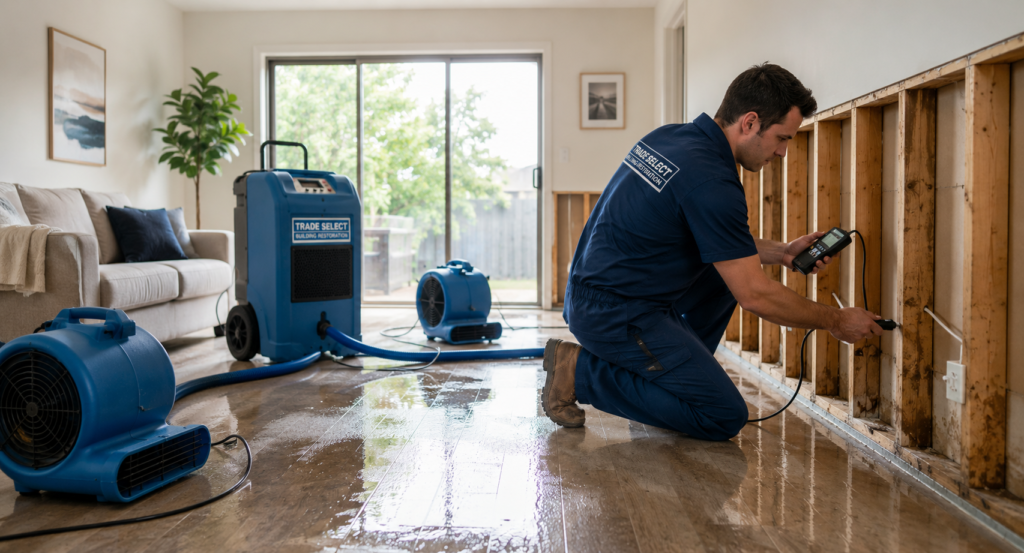
When a property takes on water, extraction is often the first job people think about. It is necessary, and in many cases it makes the site look dramatically better within a short window. But visible water removal is not the same as drying the structure. That gap is where a lot of avoidable damage starts. Wet walls, damp ceilings, saturated subfloors, swollen joinery, delayed repairs, and mould risk often come from moisture that stays trapped after the obvious water has already been removed. For us, structural drying in Melbourne is about dealing with that hidden part of the problem before it drives the repair bill higher or slows the whole recovery process down.
We provide commercial structural drying as part of a broader restoration capability that includes water damage restoration, moisture mapping, site assessments and reporting, contents restoration, and repair related services. The business is positioned around emergency and insurance focused work across Melbourne and other service regions, with IICRC certified technicians and a documented focus on technical drying and moisture control.
Visible water is only the start of the problem
A wet floor gets attention fast because it is obvious. A damp wall cavity does not. The same goes for moisture inside insulation, beneath vinyl, under carpet underlay, behind skirting boards, or inside ceiling materials. Extraction deals with the water you can remove directly. Structural drying deals with the moisture that building materials have already absorbed.
That distinction changes the outcome. Once water enters plasterboard, timber, flooring systems, ceilings, and built in elements, the job is no longer just cleanup. It becomes a moisture control problem. If that moisture is left sitting in the building fabric, the structure can keep deteriorating long after the puddles are gone.
What extraction removes well
Extraction is effective at removing standing water and reducing the immediate load on the property. It helps limit surface spread, reduces slip hazards, and gives the response team a better starting point for the next stage. In a serious water loss event, that is a necessary first move, not a complete solution. The business’s documented service mix includes both water extraction and structural drying, which reflects that separation between first removal and full drying.
What extraction leaves behind
What extraction cannot do on its own is pull moisture back out of every material that has already absorbed it. Wet plaster, damp framing, ceiling cavities, flooring assemblies, and concealed voids often retain moisture beyond what surface cleanup can reach. A room can look far better after extraction and still be carrying the conditions that lead to warping, odour, delayed reinstatement, and mould growth. That is the point many property owners discover too late.
Where extraction alone usually falls short
The practical issue is not whether extraction helps. It does. The issue is whether it solved enough of the job to protect the structure and allow the site to move forward cleanly. In many cases, it did not.
Wet walls and ceilings that keep holding moisture
Walls and ceilings can retain moisture without showing the full extent of the problem on the surface. A tide mark, a small stain, or a slightly soft finish may only hint at what is sitting behind the lining. Once water gets into cavities or porous materials, the building can stay wet in ways that are not obvious to the eye. Drying wet walls and ceilings properly means addressing what the material is holding, not just what was pooling on the floor below.
Delayed repairs because materials have not reached a dry standard
Builders and property managers often run into the same bottleneck after a water event. The visible mess is gone, but the site is not actually ready for repair. Finishes cannot be reinstated confidently. Joinery work may need to wait. Painting, flooring, plastering, or rebuilding can stall because the substrate is still damp. That delay affects timing, cost, access, and coordination across the whole project. Our service portfolio explicitly includes repair and maintenance support alongside restoration, which makes drying a practical bridge into the next stage rather than an isolated technical task.
Warped materials, swelling, and avoidable replacement
Moisture that stays inside the building fabric can change the condition of materials that might otherwise have been salvageable. Timber can move. Skirtings can swell. Flooring systems can distort. Adhesives can lose performance. Ceiling materials can weaken. Once that secondary damage sets in, the job often shifts from controlled drying to more extensive replacement. That is why proper drying is less about convenience and more about preserving as much of the structure as possible.
Mould risk when dampness stays trapped
Mould remediation is one of our core services because prolonged dampness creates the conditions that support microbial growth. SafeWork NSW advises cleaning up wet areas and water damage promptly within 24–48 hours, which reinforces why structural drying needs to happen quickly when moisture has moved beyond the visible surface.Not every water incident becomes a mould job, but incomplete drying leaves the property in a much weaker position. If moisture remains trapped in walls, under floors, or in enclosed spaces, the risk does not disappear just because the surface looks better. Fast, controlled drying helps reduce the chance that a water loss develops into a mould related restoration issue.
What structural drying is actually designed to do
A lot of confusion around structural drying comes from the way people picture the service. It is not just putting equipment in a room and waiting. It is a directed process designed to reduce moisture inside structural and finish materials so the building can move towards a stable, repair ready condition.
Drying the building, not just removing the puddle
That is the central difference. Extraction handles free water. Structural drying targets the moisture that remains inside the building after extraction is finished. We approach it as part of a larger restoration plan, especially on jobs where hidden migration, affected cavities, or material absorption are likely. The company research materials consistently position structural drying as a core technical service within the broader water damage restoration process.
How airflow, dehumidification, and moisture monitoring work together
Effective drying relies on more than one action. Air movement, dehumidification, moisture readings, and the way affected spaces are assessed all work together to remove retained moisture in a controlled way. The aim is not to create noise and heat for the sake of activity. It is to reduce moisture where it is sitting, track the drying direction, and make decisions based on actual conditions rather than surface appearance. The business research dossier and technical overview both describe the company’s restoration methodology as grounded in structural drying, moisture management, and site assessment capability.
Why structural drying changes the outcome in Melbourne properties
For people making a decision right now, this is the part that counts. Structural drying is not a technical add on. It changes what happens next.
Faster path to repair and reinstatement
When a property is dried properly, the next phase becomes easier to plan and execute. Builders can work from a more stable starting point. Property managers can move projects forward with fewer unknowns. Homeowners get clearer expectations around what needs repair and what can be preserved. On water affected jobs, delays rarely come from the parts everyone can see. They come from what sits behind the surface and holds the work up.
Better protection for walls, ceilings, flooring, and joinery
Proper drying gives affected materials a better chance of being preserved before swelling, distortion, or breakdown pushes them into replacement territory. That applies across residential and commercial sites. It is one of the reasons structural drying is so relevant for homeowners trying to avoid larger repair costs, and for commercial stakeholders trying to control downtime and loss exposure.
A clearer basis for restoration planning
Drying also helps define the scope of the broader restoration job. Once the moisture profile is understood, decisions around demolition, salvage, reinstatement, reporting, and insurer communication become more grounded. Our research materials repeatedly position the business as working with insurers, loss adjusters, brokers, builders, commercial owners, and domestic clients, so that clarity is not a side benefit. It directly shapes how the job moves forward.
How we assess whether a property still needs structural drying
We do not assume every water event needs the same drying response. We assess the property, the material types, the likely moisture path, and the condition of the affected areas before deciding what the job requires.
Checking beyond the visible surface
We look beyond what is obvious. A dry looking carpet does not prove the underlay is dry. A wall that feels firm does not confirm the cavity behind it is clear. A ceiling stain does not tell you how much moisture has travelled laterally through the surrounding material. This is where a lot of false confidence starts, especially after a leak has been stopped and the site appears calmer than it did a few hours earlier.
Using readings and mapped moisture patterns to guide drying
Our service capability includes moisture mapping and site assessments, which support a more accurate view of how far water has spread and where active drying is likely to be needed. That helps us distinguish between areas that can be monitored and areas that need intervention. Search data linked to the business also shows strong impression volume for moisture mapping and structural drying terms, which supports how central this service logic is to the site’s search opportunity.
Knowing when extraction was enough and when it was not
This matters because not every property owner wants the largest possible scope. Neither do we. The better result is a drying plan that matches the actual moisture conditions. Sometimes extraction and limited drying are enough. Sometimes they are not even close. The job is to know the difference before secondary loss takes over.
Who should act quickly when water has affected the building fabric
The answer is broader than many people think.
Homeowners trying to avoid bigger repair bills
If water has affected walls, ceilings, flooring, cabinetry, or built in materials, waiting can make the repair outcome worse. Early drying gives the property a better chance of staying within a manageable restoration scope.
Builders waiting on dry conditions before work can continue
For builders, incomplete drying means lost momentum. Reinstatement work can only move properly when the substrate is ready. Otherwise, the risk simply gets pushed into the next trade stage.
Property managers trying to reduce downtime and escalation
Property managers often have to balance tenant communication, building access, contractor timing, and owner expectations at the same time. Structural drying helps reduce unknowns, which makes the broader management task more controllable. The business’s documented audience includes commercial entities, property related stakeholders, insurers, and domestic clients, which aligns directly with this mix.
What happens when drying is delayed
Here is the blunt version. Delay rarely leaves the job unchanged. It usually expands it.
Moisture sits longer in the structure. Materials have more time to distort. Odours become more established. Repairs get pushed back. Mould risk rises. Reporting becomes more complicated. Commercial disruption stretches out. What could have been a controlled drying job can become a much broader restoration and reinstatement problem. That is why extraction alone often fails as a final answer. It handles the obvious stage of the loss, then leaves the hidden stage to keep developing.
The questions people ask when they think extraction solved it
If the carpet is dry, can the walls and subfloor still be wet?
Yes. Surface dryness does not confirm that underlying materials or concealed areas are dry. Water often remains in underlay, subfloors, cavities, or adjacent materials after the visible surface has improved.
How do I know whether extraction was enough after a water leak?
You need to know whether moisture remains in affected building materials, not just whether the room looks cleaner. That is where structural drying assessment and moisture checking become valuable.
Can structural drying reduce the chance of mould after water damage?
It can help reduce that risk by addressing retained moisture before damp conditions persist long enough to support mould growth.
Why do repairs get delayed when a property still feels only slightly damp?
Because finishes and reinstatement work often depend on what is happening inside the substrate, not only what can be felt at the surface. Damp structural materials can hold the job up even when the room seems mostly dry.
Is structural drying only for major floods, or also for smaller internal leaks?
It can be relevant for both. A smaller internal leak can still soak walls, ceilings, cabinetry, flooring systems, or cavities in ways that require more than extraction.
When should I call for structural drying in Melbourne?
As soon as there is reason to think water has affected the building fabric beyond a simple surface spill. Fast assessment gives you a clearer chance of limiting secondary damage and keeping the recovery process under control.
Do not let hidden moisture decide the repair bill
If water has affected your property, extraction may be only the first part of the response. We provide structural drying, water damage restoration, moisture assessment, and restoration support to help you deal with the moisture you cannot see before it creates a much bigger problem. If you need structural drying in Melbourne, contact Trade Select Building Restoration now so we can assess the site, identify trapped moisture, and help you move towards repair with more certainty.
