 Skip to content
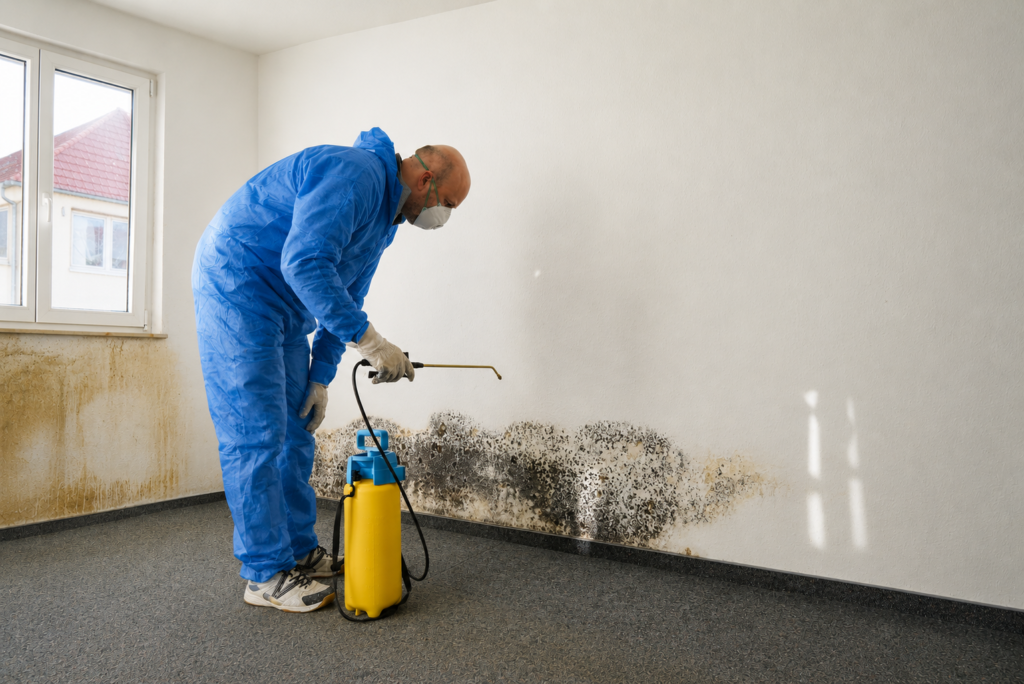
When mould shows up in a commercial or shared occupancy building, the problem is rarely limited to what can be seen on the surface. By the time visible growth is noticed, there is often a broader issue involving moisture, hidden spread, occupancy concerns, access restrictions, and the pressure to respond without turning the building into a major disruption zone. That is why we treat commercial mould remediation as a building management and risk control process, not a cosmetic clean up. For offices, schools, and strata sites, the right response needs to contain the issue, address the moisture conditions behind it, and create a workable path forward for the people responsible for the property.
Our documented service mix includes mould removal and remediation, commercial drying services, site assessments and reporting, water damage restoration, structural drying, odour control, and broader restoration support. The business research materials also position us as a provider serving commercial entities, insurance related stakeholders, and domestic clients across multiple regions, with IICRC certified technicians and a restoration model built around technically managed response work.
Why commercial mould problems are rarely just a cleaning issue
In a house, mould is already a serious issue. In an office, school, or strata environment, it becomes more layered. There are more people involved, more competing priorities, and more consequences attached to getting the response wrong. Occupants may be worried about indoor air quality. Managers may be dealing with complaints, tenancy pressure, or reputational fallout. Access to affected areas may be limited. Building operations may need to continue while part of the site is being assessed or remediated.
That changes the standard. A wipe down approach might make the visible growth look better for a short period, but if the moisture source remains, if the contaminated area is not managed properly, or if adjacent spaces are not protected, the problem often comes back. Worse than that, it comes back after time, money, and confidence have already been spent.
What makes mould remediation in occupied buildings more complex
Occupied buildings do not give you the same freedom as a vacant site. Works have to be planned around people, access, communication, and continuity.
The Western Australia Department of Health recognises mould as a key indoor biological pollutant that may cause adverse health effects to building occupants and notes that it can also damage building materials, contents, and structures, leading to expensive maintenance and management costs. This is one reason commercial mould issues often require a broader risk management response rather than a simple cleaning program.
Offices: staff comfort, tenant expectations, and workflow disruption
In office environments, mould can quickly become a workplace confidence issue. Even when the affected area is limited, staff and tenants usually want to know what is being done, whether the area is safe to access, and whether the issue could be more widespread than it appears. Facility managers are often balancing the technical response with business continuity, contractor coordination, and the need to avoid disruption rippling through the site.
Schools: duty of care, room access, and timing around student occupancy
Schools have a different kind of pressure. There is a duty of care element that changes how decisions are made, and access planning often has to work around class schedules, administration needs, and the movement of students and staff. A remediation plan that ignores occupancy realities is not much use in a school setting. The response has to be practical enough to fit the building’s daily function while still protecting the integrity of the remediation works.
Strata buildings: shared services, common areas, and competing stakeholder priorities
Strata properties bring their own complexity. The affected area may sit between lot and common property responsibilities. Multiple occupants may be involved. Access approvals can take time. Committees, strata managers, owners, tenants, and contractors may all need different information at different stages. In those environments, mould remediation is not only a technical exercise. It is also a coordination exercise, and weak coordination has a habit of slowing everything down.
Why surface cleaning often fails in commercial mould situations
This is where a lot of commercial properties lose time. The response focuses on what is visible, but not on what is causing the mould to persist.
The difference between visible mould and the underlying moisture issue
Visible mould is the symptom. Moisture is the driver. If damp building materials, condensation conditions, concealed leaks, or retained water damage are still present, cleaning the surface does not resolve the underlying problem. It may temporarily improve appearance, but it does not change the conditions that allowed mould to grow in the first place. The business research and service materials consistently connect mould remediation to drying, moisture control, assessments, and broader restoration work, which supports treating it as a systems issue rather than a surface issue.
How repeated recurrence creates cost and credibility problems
When mould returns after a basic clean up, the damage is not only physical. Commercial managers can lose confidence in the contractor, the process, and the building’s condition. Complaints can intensify. Tenants may question whether the issue was ever handled properly. In schools and strata settings, even a small recurring problem can create disproportionate concern because people read recurrence as proof that the original issue was not controlled. That is one reason containment, proper remediation, and moisture management need to sit together in the same response strategy.
What a proper commercial mould remediation process needs to include
A good commercial remediation plan does not need to be dramatic. It needs to be structured.
Containment that protects occupied or adjacent areas
Containment matters because commercial mould remediation often happens in buildings that are still active, at least in part. Offices may have adjacent teams working nearby. Schools may have rooms that need to remain in use. Strata buildings may have common areas and access paths that cannot simply be shut down without planning. A containment led approach helps reduce contamination spread and gives the works a defined boundary, which makes the overall response more controlled and easier to manage.
Staged remediation that works around building operations
On an occupied site, the response often needs to be staged. That could mean isolating one area while keeping another operational, sequencing works around access windows, or coordinating remediation with maintenance, drying, or repair requirements. The point is not to pretend there will be no disruption. The point is to reduce unnecessary disruption by planning the work around how the building actually functions.
Drying and moisture control so the problem does not return
Commercial mould remediation is rarely durable if the site remains damp. If moisture is still sitting in walls, ceilings, flooring systems, cavities, or finishes, the risk stays alive even after visible growth has been addressed. Our documented service capability includes commercial drying services, structural drying, moisture mapping, and site assessments, which is relevant because mould remediation often needs to connect directly to those moisture control steps.
Clear reporting for owners, managers, and stakeholders
Commercial properties usually involve more than one decision maker. Facility managers may need internal records. School operators may need a clear explanation for staged access and response timing. Strata managers may need documentation that supports communication with owners, committees, and contractors. The business’s documented site assessment and reporting capability makes that reporting function a natural part of the service logic rather than an afterthought.
How mould management changes across offices, schools, and strata sites
The mould may be similar. The management context is not.
Office environments
In offices, the main pressures usually centre on staff comfort, reputational control, tenancy expectations, and continuity. A mould issue in an office can affect meeting rooms, open plan workspaces, amenities, records areas, and shared ventilation related concerns. The response needs to account for how people move through the building and which areas can realistically be isolated without creating wider operational problems.
Educational facilities
In schools, the context shifts towards duty of care, room scheduling, administration planning, and student facing impacts. There is less tolerance for uncertainty, and rightly so. Even where the mould issue is localised, the remediation plan needs to reflect the practical reality that people still need to use the site. Timing, communication, and containment all carry more weight when the building supports daily educational activity.
Strata and multi occupancy buildings
In strata environments, mould can affect common areas, service zones, basements, corridors, plant areas, ceiling spaces, or the interface between common property and lots. That creates a more layered responsibility picture. One occupant’s complaint can trigger a broader investigation. One damp area can involve multiple parties. This is where a structured, clearly communicated remediation approach becomes especially valuable, because without it the issue can drift into delay, disagreement, and recurring patch up work.
Why commercial drying is often part of the remediation picture
A commercial mould problem often begins with moisture, and it often stays alive because moisture remains.
Hidden dampness behind walls, ceilings, and finishes
Buildings can carry dampness in concealed or semi concealed areas long after the original water event or moisture source seemed minor. Walls, ceilings, cavities, skirtings, flooring layers, and built elements can all retain enough moisture to support an ongoing mould issue. That is why visual improvement is not the same as environmental improvement. A better looking surface does not necessarily mean the building has moved back to a stable condition.
Why remediation without moisture control is rarely durable
If the moisture issue is left partially unresolved, the remediation result becomes fragile. The building may look recovered for a while, then slip backwards. This is why moisture control should be treated as a core part of commercial mould remediation, not a secondary concern. The Australian Institute of Health and Welfare reports that mould is estimated to affect 10%–50% of indoor environments across Australia and several other regions, and notes that well-designed, well-constructed and well-maintained buildings are important for preventing and controlling the excess moisture and humidity that can lead to mould growth.
That is why we see commercial drying and moisture control as part of the remediation picture, not as a separate technical add on. Search and service research tied to the business also shows strong relevance for structural drying, moisture mapping, water damage restoration, and related moisture focused services, which reinforces how central this part of the process is to the broader service offering
What decision makers should look for before appointing a contractor
Commercial decision makers do not need inflated promises. They need a contractor whose approach matches the reality of the building.
A containment led approach, not a cosmetic clean up
If the plan focuses only on removing visible mould without dealing with spread control and moisture conditions, that is a warning sign. The response should be designed to reduce contamination movement, not just improve the look of the affected surface.
Experience working in occupied buildings
Occupied sites require more than technical remediation skills. They also require practical staging, communication, and a clear understanding of access constraints, occupant concerns, and operational realities. Research materials linked to the business position us around commercial, insurance, and restoration work across multiple property contexts, which supports that occupied building relevance.
Clear communication, staging, and reporting
The more stakeholders involved, the more valuable structure becomes. A commercial remediation process should make it easier for managers to explain what is happening, what is being contained, what the next steps are, and where the response is heading.
A path from remediation into drying and broader restoration if needed
Sometimes mould remediation is the core job. Sometimes it sits inside a bigger building recovery issue involving water damage, drying, odour control, or repairs. A contractor who can connect those stages more cleanly is often better placed to reduce delay and fragmentation. Our documented service mix includes that broader pathway.
What our approach is designed to achieve in commercial mould jobs
We approach commercial mould remediation with a simple objective. Get control of the issue in a way that makes the next decision easier, not harder.
Reduce contamination spread
We focus on containment and controlled remediation so the affected area does not create wider problems for adjacent spaces or occupants.
Protect building operations where possible
On occupied sites, we plan with the building in mind. That means thinking about access, staging, coordination, and how to reduce unnecessary disruption while still addressing the problem properly.
Create a clearer path to recovery and ongoing management
We also aim to give managers a clearer path forward. That may include remediation, drying, reporting, and the next practical step towards restoring stable building conditions. Our service portfolio, as documented in the research materials, supports that broader response model across mould, drying, restoration, and reporting work.
The questions commercial clients ask before remediation begins
Can commercial mould remediation be carried out while part of the building stays occupied?
In many cases, yes, but it depends on the location of the mould, the building layout, the containment requirements, and how the works can be staged. Occupied building planning is often central to the remediation approach.
What is the difference between mould cleaning and mould remediation?
Cleaning usually focuses on visible surface treatment. Remediation is broader. It is concerned with managing the affected area properly, controlling spread, and addressing the moisture conditions behind the problem.
Why is containment necessary in an office, school, or strata environment?
Because those environments often have adjacent occupied areas, shared access, and higher sensitivity to spread, disruption, and stakeholder concern. Containment helps keep the response controlled.
Does mould remediation also include fixing the moisture issue?
It should include a clear response to the moisture issue, whether that means source control, drying, assessment, or a staged moisture management plan. Without that, the result is less likely to hold.
How do you minimise disruption during commercial remediation works?
By planning the response around access, occupancy, and staging rather than treating the site as though it were vacant. That is especially relevant in offices, schools, and strata buildings where operations or shared access usually need to continue in some form.
When should a mould management plan be considered?
A mould management plan is worth considering when mould affects an occupied building, recurring moisture issues are present, shared or sensitive areas are involved, or multiple stakeholders and stages of work require a coordinated response.
When mould affects people, operations and property, a structured plan helps manage the response effectively.
Commercial mould remediation is not just about removing what is visible. It is about containing the issue, controlling the moisture behind it, reducing disruption where possible, and giving decision makers a clearer way to move forward. We provide mould remediation, commercial drying, moisture focused restoration support, and reporting led assessment so offices, schools, and strata properties can respond with more control and less guesswork. If you need help assessing a mould issue in a commercial or shared occupancy building, contact us and we can help map out the next practical step.
